AI Agent Platform vs AI Automation Agency: Which One Do You Need?
An AI agent platform can help you build agents faster. An AI automation agency can help you choose the right workflow, design guardrails, connect systems, and turn the agent into a reliable business process. This guide shows which path fits your team.
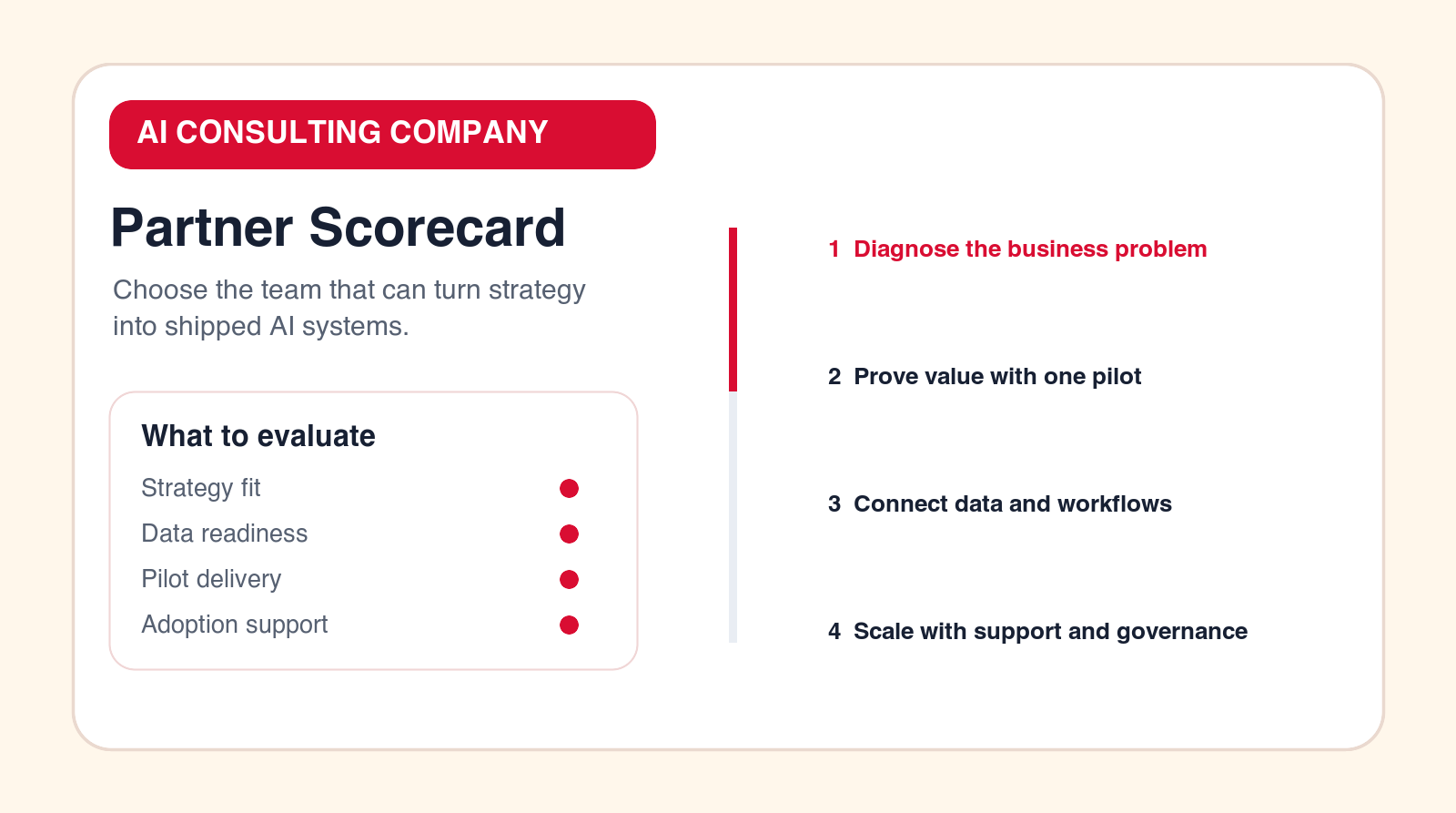
Best decision signal
Choose software when the workflow is already clear. Choose agency help when the workflow, data, guardrails, or rollout still need design.
Focus
AI agent platform
Decision point
Implementation planning
What it compares
Platform, agency, and hybrid
Main service
AI Agent Development
TL;DR
Choose an AI agent platform when your workflow is already documented, your team can configure and maintain agents, integrations are standard, risk is low, and you mostly need a tool. Choose an AI automation agency when you need help choosing the use case, mapping the workflow, cleaning data, connecting systems, designing human review, building custom AI agents, training users, or measuring ROI. Many businesses need a hybrid model: a platform for agent execution and an agency for workflow design, implementation, and rollout.
The search for an AI agent platform usually starts with a simple question: which software should we use to build AI agents? That is a valid question, but it is not the first question most businesses should ask. The better first question is: what business workflow should the agent own, what is it allowed to do, and who reviews the outcome?
AI agent platforms are useful. They can provide builders, templates, connectors, orchestration, memory, tool calling, permissions, and monitoring. But a platform does not automatically know your sales process, customer support rules, invoice approval thresholds, CRM data quality, legal risk, privacy expectations, or adoption problems. Those are operating design questions.
An AI automation agency solves a different part of the problem. The agency should help you choose the right use case, define the agent role, map the workflow, design guardrails, connect systems, test edge cases, train users, and support the rollout. In practice, the best answer is often not platform or agency. It is platform plus agency, with each one doing the work it is actually good at.
Quick Answer: Platform, Agency, or Hybrid?
Use an AI agent platform if the workflow is already clear and your team has the capacity to build. Use an AI automation agency if the workflow still needs design or if the agent will touch important customer, finance, support, sales, or operations systems. Use a hybrid model if you want a platform as the technical base but need implementation support to make it work in the business.
This is the simplest way to think about the decision. A platform gives you agent-building capability. An agency gives you operating judgment and delivery support. If your team already has operating judgment, technical capacity, and time, software may be enough. If the team is still asking what to automate, how to connect the workflow, or how to keep the agent safe, agency support will reduce wasted effort.
| Decision area | AI agent platform | AI automation agency | Hybrid model |
|---|---|---|---|
| Best for | Clear workflows and internal builders. | Workflow design, custom build, rollout, and guardrails. | Businesses that want a tool plus implementation help. |
| Main risk | Buying software before the process is ready. | Over-scoping if discovery is not practical. | Unclear ownership between client, platform, and agency. |
| Speed | Fast if the team knows what to build. | Fastest when the first workflow needs design first. | Strong when the agency can build on the platform quickly. |
| Ownership | Mostly internal. | Shared during build, then handed over or supported. | Shared technical and operational ownership. |
What an AI Agent Platform Actually Does
An AI agent platform is software for creating, running, and managing AI agents. Depending on the product, it may include prompt builders, model selection, tool connectors, workflows, knowledge bases, memory, evaluation tools, logs, permissions, and deployment options. The promise is speed: your team can create agents without building the whole infrastructure from scratch.
That can be valuable. A platform may help a team build a support triage agent, research assistant, meeting follow-up agent, document extraction workflow, lead qualification agent, internal knowledge assistant, or reporting assistant. If the workflow maps cleanly to the platform's connectors and your team knows how to configure the logic, the software can shorten the path to a working pilot.
The limitation is that platforms are usually workflow-neutral. They provide capability, but they do not automatically decide which business process deserves automation, how approvals should work, where data is unreliable, what users will accept, or how the system should be supported after launch. Those decisions sit outside the platform interface.
What an AI Automation Agency Should Actually Do
An AI automation agency should not simply sell generic AI advice. The useful agency work is practical: finding the first use case, mapping the current process, designing the target workflow, choosing tools, building AI agents, connecting systems, testing real examples, training users, and measuring whether the workflow actually improves operations.
In a good engagement, the agency helps turn a vague idea into an implementation brief. Instead of "we need AI agents," the brief becomes "we need an AI agent that reviews inbound demo requests, checks the CRM, scores fit, drafts a reply, creates the right task, and sends edge cases to a sales owner." That level of specificity is what makes AI agent development useful.
The agency should also know when not to build. If an off-the-shelf AI agent platform is enough, the agency should say so. If the workflow is too risky for automation, the agency should recommend preparation, human review, or process cleanup. The best AI automation agency protects the business from wasted software spend and overbuilt custom systems.
Free fit check
Find out whether you need a platform, an agency, or both.
Drop your email and we will send a first-pass recommendation for your workflow, including what software can handle and where agency support may be useful.
No spam. We use this to reply with the recommendation.
1. Choose a Platform When the Workflow Is Already Clear
An AI agent platform works best when the process is already documented. You know the trigger, the inputs, the source systems, the steps, the approval path, and the desired output. The agent has a specific job, such as classifying tickets, drafting meeting follow-ups, searching a knowledge base, preparing account research, or updating low-risk CRM fields.
If your team can describe the workflow in plain language and the platform supports the required integrations, software may be enough. The platform gives you a faster way to configure the agent, connect approved tools, test outputs, and monitor runs. The team still needs to own the process, but it may not need a full agency build.
The warning sign is vague language. If the brief says "automate sales" or "use AI for operations," the workflow is not ready for platform configuration. The team will spend time inside the tool trying to discover the process. That usually leads to half-built agents, disconnected experiments, and low adoption.
2. Choose an Agency When the Process Needs Design
Many businesses do not have a software problem at the start. They have a process clarity problem. The work is slow because ownership is unclear, handoffs are informal, data is inconsistent, approvals are scattered, or people disagree about the right next step. In that situation, buying an AI agent platform too early can turn messy operations into messy automation.
An AI automation agency can help map the current process before any agent is built. This includes identifying where work starts, where it gets stuck, which systems are involved, which decisions require judgment, which data is missing, and what the first useful agent should do. The agency should then narrow the pilot so it can be tested quickly.
This is especially important for workflows that cross teams. Sales handoff, customer onboarding, invoice approval, support escalation, renewal risk, proposal drafting, and compliance evidence collection often involve several owners. The agent will only work if those owners agree on the process.
3. Compare Internal Capacity Before Buying Software
Platforms look self-service, but useful AI agents still need builders. Someone must configure the workflow, write instructions, connect tools, test examples, check outputs, handle errors, train users, and improve the agent after launch. If nobody internally has time or ownership, the platform can become another subscription that never becomes part of operations.
This does not mean every company needs an agency. A team with a strong operations owner, technical admin, clean systems, and time to test can build a lot with an AI agent platform. The practical question is whether those people exist and whether they can prioritize the work. If the answer is yes, software-first can be reasonable.
If the team is already overloaded, agency support can make the difference between a demo and a deployed workflow. The agency can own discovery, configuration, integration, testing, and rollout while still involving internal owners. The business should not outsource judgment completely, but it can outsource the build and implementation burden.
4. Use an Agency When Integrations Are Custom or Fragile
AI agents become valuable when they can act inside real business systems: CRM, help desk, email, calendar, project management, finance tools, document stores, databases, analytics platforms, and internal applications. If the required integrations are standard and the platform already supports the fields and actions you need, software may be enough.
Agency support becomes more important when integrations are custom, fragile, undocumented, or spread across several tools. A platform connector may say it supports a CRM, but that does not mean it supports your custom fields, approval logic, duplicate rules, record ownership, or reporting needs. The difference between logo-level integration and workflow-level integration matters.
A good agency will inspect what the agent must read and what it must write. It will define which actions are safe, which require review, and which should stay manual. It will also design fallback paths when data is missing, permissions fail, or an API returns an unexpected result. Those details rarely show up in platform marketing, but they matter in production.
5. Use a Platform When Templates Match the Use Case
Platforms are strongest when your use case matches a common pattern. Examples include internal Q&A, simple research assistants, meeting summaries, ticket classification, email drafts, document extraction, lead enrichment, and basic CRM task creation. If the platform has a template that closely matches your workflow, starting there can save time.
The key phrase is "closely matches." A template is helpful when it reduces configuration, but it should not force the business into the wrong process. If the template assumes a sales motion, support model, approval path, or data structure that does not match your team, the agent may create more checking work than it removes.
When a template is almost right but not enough, an agency can adapt the pattern. The agency may use the platform as the base, then customize prompts, data sources, permissions, review steps, and reporting. That gives you speed without accepting a generic workflow.
6. Use an Agency When AI Agents Need Guardrails
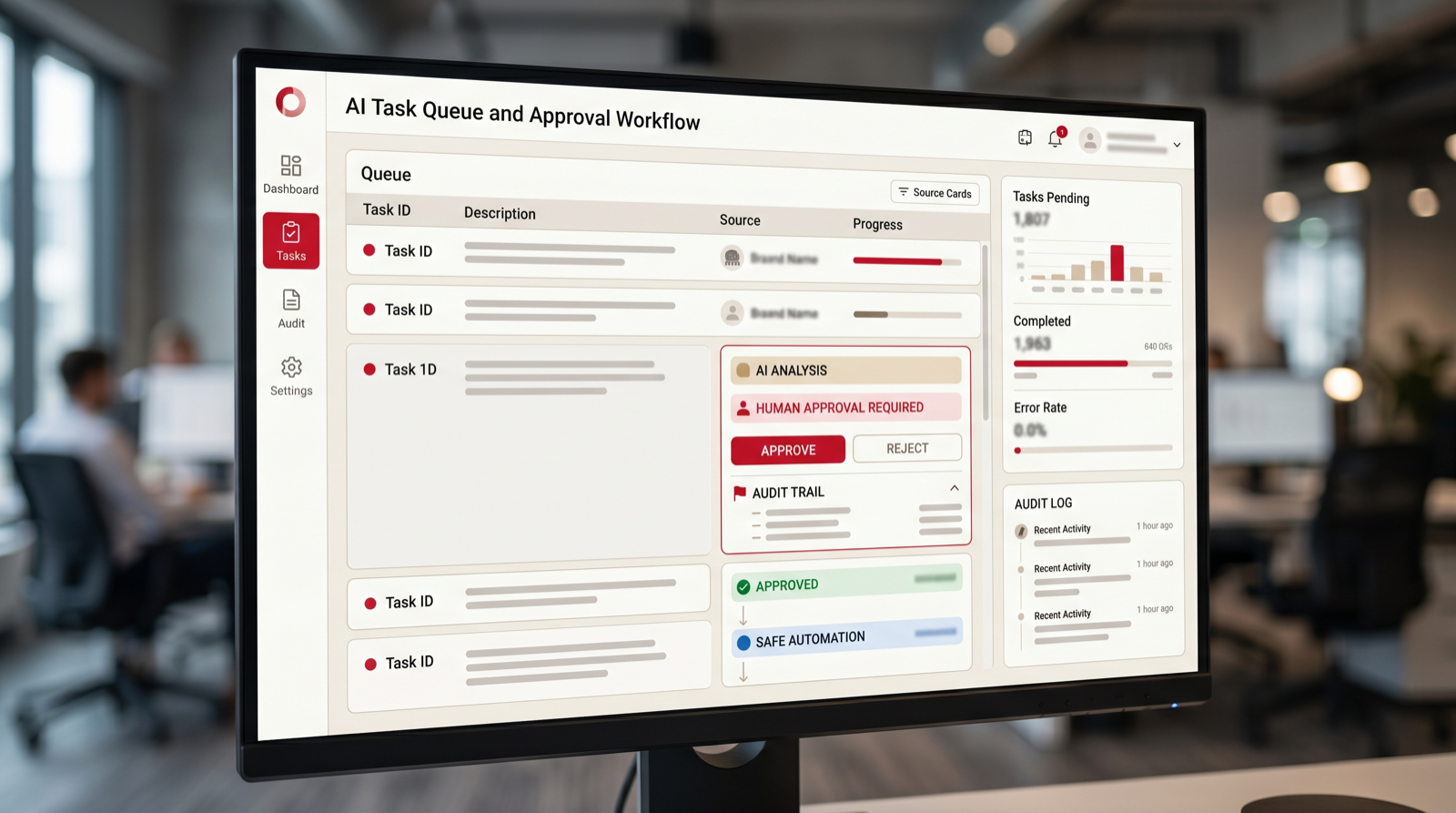
Guardrails are the operating rules that define what an AI agent can and cannot do. They include system permissions, data boundaries, source requirements, review rules, escalation paths, logging, monitoring, and approval thresholds. They are especially important when the agent touches customers, finance, HR, legal, security, or compliance.
Some AI agent platforms include guardrail features, but the platform cannot decide your business policy by itself. The business must define which actions are draft-only, which are automatic, which require approval, and which are not allowed. For example, an agent might draft a customer email but not send it, create an internal task but not approve a refund, or summarize a candidate interview but not make a hiring decision.
An AI automation agency can help design these guardrails around the actual workflow. That includes testing edge cases, creating review prompts, defining exception handling, and making sure users understand what the agent does. Without guardrails, AI agent development can move fast in a demo and become risky in real operations.
7. Compare Total Cost, Not Just Platform Subscription
Platform pricing is only one part of the cost. The total cost includes discovery, configuration, integration, testing, data cleanup, security review, training, maintenance, and support. A low monthly subscription can still become expensive if the team spends months trying to build a workflow that should have been scoped differently.
Agency work costs more upfront, but it can reduce waste when the team lacks implementation capacity. The value is not only the build. It is avoiding the wrong use case, wrong platform, wrong integration path, or wrong level of autonomy. A practical agency engagement should produce a working pilot and a clearer operating model, not endless strategy slides.
The best cost comparison asks what the company gets after thirty, sixty, and ninety days. Is the agent live? Are users adopting it? Are errors visible? Is manual work lower? Is the team clearer about the next workflow? If not, a cheap platform may be expensive in attention and lost momentum.
8. Compare Speed to Value, Not Speed to Demo
AI agent platforms can produce fast demos. That is useful for exploration, but a demo is not the same as an operating workflow. A real workflow needs permissions, examples, testing, error handling, user adoption, reporting, and support. The relevant speed metric is not "how fast can we create an agent?" It is "how fast can the business trust and use the workflow?"
Software-first can be fastest when the team already knows what to build. Agency-first can be fastest when the team needs help deciding what to build. A short discovery sprint may feel slower than opening a platform, but it can prevent weeks of trial and error. The goal is speed to useful deployment, not speed to a prototype nobody uses.
A hybrid path can be the fastest practical route. The agency maps and builds the first workflow on a suitable platform, then hands over the pattern. The business gets a working pilot and learns how future agents should be scoped, tested, and supported.
9. Review Data Access, Privacy, and Security Early
AI agents need context. That context may include customer records, support tickets, contracts, invoices, internal notes, employee data, sales activity, or operational reports. Before choosing a platform or agency, decide what the agent needs to read, what it can write, where logs are stored, who can inspect outputs, and how sensitive data is handled.
A platform may provide security features, but configuration still matters. The business must avoid giving the agent broad access when a narrow permission set is enough. It must also know whether data is used for training, how retention works, what audit logs exist, and whether the tool fits internal compliance requirements.
An agency should help translate security requirements into workflow design. That means minimizing data access, defining role-based permissions, creating review points, and documenting how the agent interacts with systems. If an agency dismisses security as a later concern, that is a warning sign.
In 2026, buyers should also ask a direct data-use question: can the platform or model provider use prompts, files, outputs, or human corrections to train or improve its systems? The answer affects customer data, internal documents, and competitive information. A good agency should be able to help interpret those settings and design the workflow so the agent only sees what it needs.
This is not only a legal issue. It is an operating issue. If the business cannot explain where agent logs live, who can inspect them, and how long they are retained, it will struggle to troubleshoot mistakes or satisfy internal stakeholders later.
10. Do Not Underestimate Rollout and Adoption
AI agents change how people work. Even a technically correct agent can fail if users do not understand it, trust it, or know how to report problems. Rollout is not a final announcement. It is part of implementation. Users need to know what the agent does, what it does not do, which outputs they review, and how the workflow will be measured.
Platforms usually provide the tool, but adoption still belongs to the business. If the team has strong internal change management, it may handle rollout alone. If users are skeptical, workflows cross departments, or the agent changes daily habits, agency support can help with training, documentation, launch groups, feedback loops, and iteration.
The first rollout should be small. Launch to a controlled group, watch how they use the agent, collect corrections, improve the workflow, and expand only after the system proves useful. A good AI automation agency will push for this kind of measured rollout instead of forcing a big-bang launch.
11. Decide Who Maintains the Agent After Launch
AI agents need maintenance because business workflows change. CRM fields change. Support categories change. Pricing rules change. Knowledge bases become outdated. Approval thresholds move. A workflow that works today can become wrong later if nobody owns updates.
With a platform-only approach, maintenance is mostly internal. Someone must monitor runs, review failures, update prompts or rules, adjust integrations, and train users on changes. With an agency-led approach, maintenance may be handled through a support agreement or a handover model. Either way, ownership must be clear before launch.
The handover should include workflow documentation, agent instructions, tool permissions, test examples, error-handling notes, reporting metrics, and support responsibilities. If the business cannot see how the agent works, it becomes dependent. If the handover is clear, the business can keep improving the workflow.
12. The Best Answer Is Often a Hybrid Model
Many businesses should not choose between a platform and an agency. They should choose the right platform with the right implementation partner. The platform provides infrastructure, connectors, monitoring, and agent execution. The agency provides workflow design, AI agent development, custom integration, guardrails, testing, training, and rollout support.
The hybrid model works especially well when the business wants speed but does not want to build everything internally. The agency can use the platform to avoid unnecessary custom development, while still adapting the workflow to the company's data, systems, approvals, and users. This is often more practical than building from scratch or forcing every workflow into a generic template.
The key is ownership. The business should know which parts belong to the platform, which parts are configured by the agency, which parts the internal team owns, and what happens after launch. A hybrid model fails when responsibility is unclear. It works when each party has a defined role.
What to Automate First With AI Agents
Whether you choose a platform, agency, or hybrid model, start with one workflow. Good first AI agent workflows include lead routing, support triage, sales research, meeting follow-up, CRM hygiene, invoice intake, document extraction, weekly reporting, internal approval routing, customer onboarding, renewal risk monitoring, and internal knowledge search.
The best first workflow is frequent, measurable, and safe to review. Avoid starting with high-risk final decisions. Let the agent prepare context, draft outputs, route work, check fields, and flag exceptions first. As confidence grows, you can decide which low-risk actions should become more automatic.
This is where agency support can be valuable even if you already have a platform. An agency can help choose the first workflow, avoid over-scoping, define the success metric, and create a roadmap for the next two or three automations. That turns AI agent work into an operating program instead of a series of disconnected experiments.
A Practical 90-Day Decision and Implementation Plan
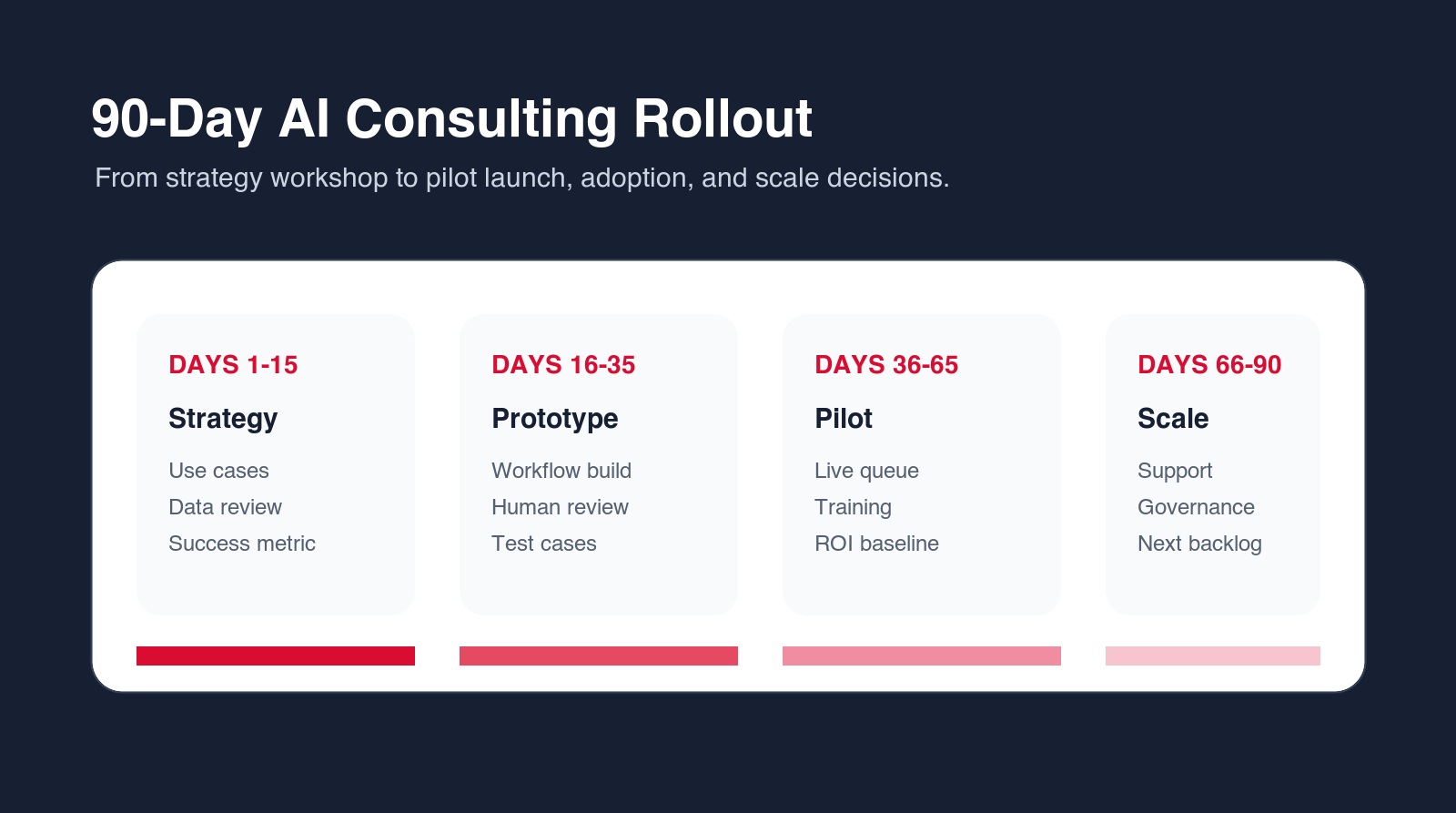
In the first thirty days, define the workflow. List candidate use cases, score them by value, readiness, risk, and owner commitment, then select one pilot. Write the workflow brief: trigger, input, systems, agent role, human review, output, exception path, owner, and metric. Compare platforms only after the workflow is clear enough to test.
In days thirty to sixty, build and test. Configure the platform or work with the agency to build the first controlled agent. Use real examples, including normal cases and edge cases. Test permissions, tool actions, prompts, outputs, handoffs, and errors. Do not launch until failed actions and review paths are visible.
In days sixty to ninety, launch to a small group. Measure time saved, review acceptance, output quality, exception rate, failed runs, adoption, and user feedback. Decide whether to expand, adjust, or pause. Use the result to choose the next workflow and improve the operating model.
The Buying Brief
A good buying brief should include the workflow, required systems, required actions, data sensitivity, review rules, reporting needs, internal owner, and support expectations. This makes vendor demos and agency proposals easier to compare. Without a brief, every platform and every agency can sound plausible.
The Minimum Pilot
The minimum pilot should be useful but narrow. It might route inbound leads, summarize support tickets, draft follow-up emails, prepare weekly reporting commentary, or extract invoice fields for review. A narrow pilot lets the team prove whether AI agents can improve real work before expanding.
Questions to Answer Before Signing
- Who owns the workflow after launch?
- Which systems will the agent read and update?
- Which actions require human review?
- How are errors, failed runs, and exceptions logged?
- What does success look like after ninety days?
How to Evaluate Platform Demos and Agency Proposals
Do not evaluate AI agent platforms with generic demos. Ask every platform vendor to show the same workflow. Use your own brief, your own example data, and your own success criteria. If the first workflow is lead routing, ask the vendor to show how the platform reads the form, checks the CRM, handles duplicates, scores fit, drafts the follow-up, creates the task, logs the action, and exposes failed runs. If the demo cannot get close to the real workflow, the product may still be good, but it is not proven for your first use case.
Ask platform vendors what happens after the happy path. What if the CRM record already exists? What if the email domain is personal? What if the form is missing budget? What if the agent is unsure? What if the API fails? What if a user rejects the agent output? A serious platform should make exceptions visible, not hide them. The demo should show how users review, correct, and improve the workflow.
Agency proposals should be evaluated differently. Do not accept a proposal that only says "we will build AI agents." Ask for the workflow discovery method, pilot scope, systems involved, data requirements, review model, timeline, handover plan, support model, and success metrics. A strong proposal explains what the agency will build, what it will not build yet, and how the first pilot will prove value before expansion.
The best agencies are specific about constraints. They should tell you when a platform is enough, when a custom AI solution is justified, when data cleanup is needed, and when automation should wait. If an agency says every workflow should become fully autonomous immediately, treat that as a risk signal. Business AI agents need staged trust. Start with preparation, drafts, routing, and recommendations. Increase autonomy only when the workflow proves reliable.
Use the same scoring model for both demos and proposals: workflow fit, integration depth, guardrails, observability, maintenance, user adoption, and ninety-day value. This keeps the decision grounded. You are not buying an AI agent platform because it has the most features, and you are not hiring an AI automation agency because it uses the most impressive language. You are choosing the path most likely to turn one important workflow into a supported operating system.
Final Decision Checklist
- Choose an AI agent platform if the workflow is already clear and your team can build, test, launch, and maintain it.
- Choose an AI automation agency if you need help choosing the use case, designing the workflow, building guardrails, or connecting systems.
- Choose a hybrid model if you want software speed plus implementation support.
- Do not buy a platform just because the demo looks impressive. Test it against your real workflow.
- Do not hire an agency that cannot explain what it will build, how it will measure success, and how it will hand over or support the workflow.
- Start with one agentic workflow, measure it, and expand only after the first pilot works.
The best choice is the one that gets a useful, trusted workflow into daily operation. If your team can do that with an AI agent platform, start there. If your team needs help turning the idea into a controlled workflow, hire an AI automation agency. If you need both capability and implementation, choose the hybrid path deliberately.
The decision should always end with ownership: who builds it, who approves it, who uses it, who measures it, and who improves it after launch.
Free AI agent fit review
Get a first-pass recommendation before buying a platform.
Send your email and we will reply with a practical view of whether your first workflow needs software, agency support, or both.
No spam. We use this to reply with the review.
FAQ: AI Agent Platform vs AI Automation Agency
What is an AI agent platform?
An AI agent platform is software for building, running, and managing AI agents. It may include workflow builders, model connections, tool integrations, memory, permissions, logs, evaluation tools, and deployment options.
When should I use an AI automation agency instead?
Use an AI automation agency when you need help choosing the workflow, designing the process, connecting systems, building custom AI agents, creating guardrails, training users, or supporting rollout after launch.
Can I use an AI agent platform and an agency together?
Yes. Many businesses use an AI agent platform as the technical base and an AI automation agency for workflow design, implementation, integrations, guardrails, testing, and rollout support.
Which option is cheaper?
A platform usually has a lower subscription cost, but total cost includes setup, workflow design, integration, testing, data cleanup, training, and maintenance. Agency support costs more upfront but can reduce wasted time and failed experiments.
Can Go Expandia help choose the right path?
Yes. Go Expandia can review your workflow, recommend whether a platform, agency-led implementation, or hybrid model is the right fit, and help build the first controlled AI agent pilot.
About Bailey Roque
Bailey Roque writes for Go Expandia on AI automation, AI agent development, workflow design, AI consulting, and practical rollout models for business teams.
Related posts
Keep comparing your AI agent options
Ready to Choose the Right AI Agent Path?
Go Expandia helps companies choose the right workflow, select the right implementation path, and launch AI agents with practical guardrails.