AI Consulting Company: How to Choose the Right Partner
The right AI consulting company should help you choose the right business problem, design a realistic pilot, connect your data and systems, and support adoption after launch. This guide gives you a practical way to compare partners before you spend money.
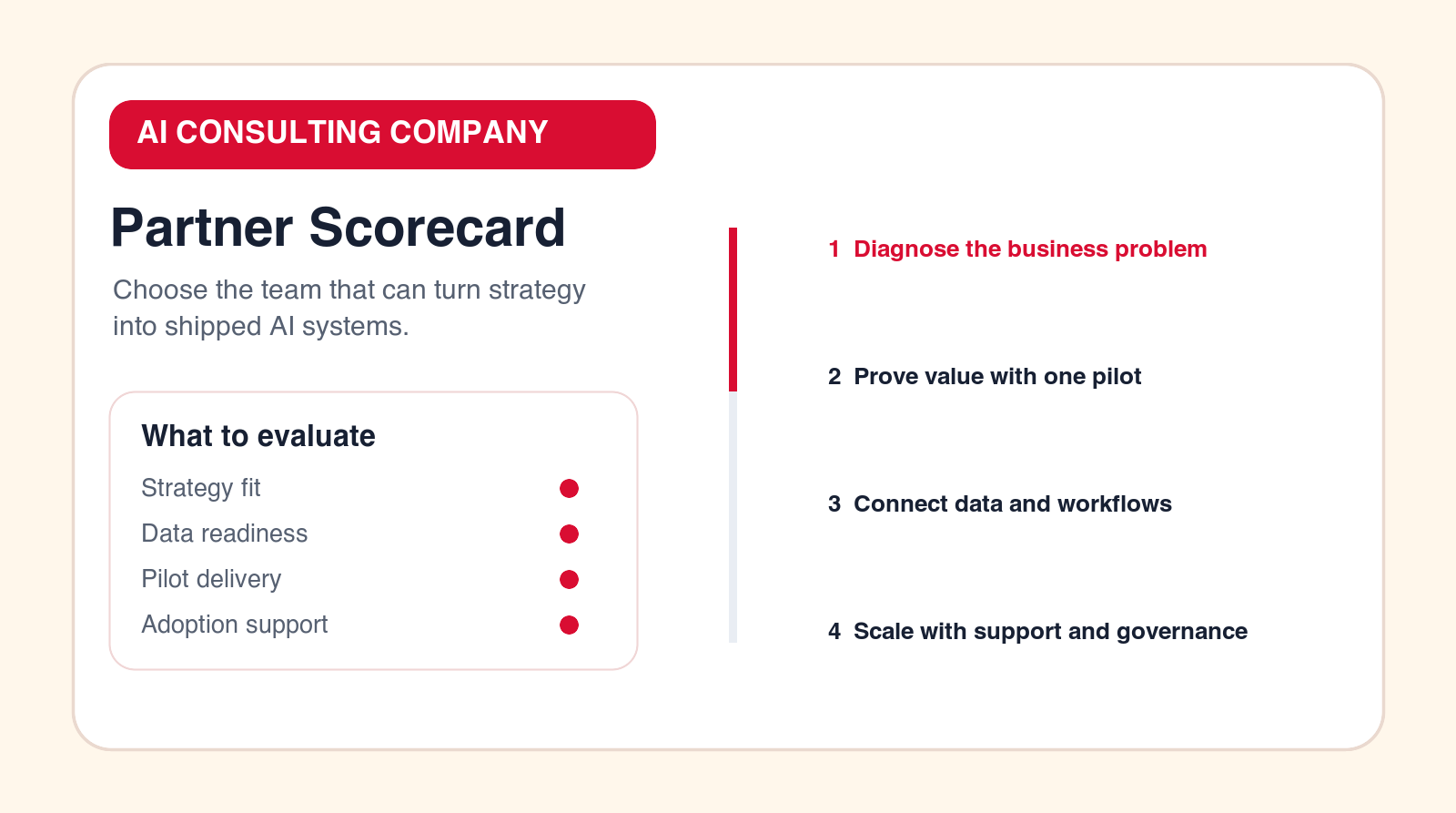
Best partner signal
A strong AI partner can turn one clear workflow into a tested pilot before promising a company-wide transformation.
Focus
AI consulting company
Decision point
Implementation planning
Best for
Teams choosing a partner
Best next step
One scoped pilot
TL;DR
Choose an AI consulting company that starts with business outcomes, not model demos. The best partner should map workflows, check data readiness, design a small pilot, build or configure the right system, add human review, measure ROI, train users, and support the system after launch. Avoid partners that promise to automate everything before they understand your process.
An AI consulting company is useful only if it helps your business move from interest in AI to a working operating improvement. Many companies know they should use AI, but they do not know which workflow to start with, what data is ready, which tools are worth buying, how AI agents should be controlled, or how to measure success after the first launch. Good consulting turns those unknowns into a clear plan.
This is why choosing the right partner matters. A weak partner sells a workshop, a slide deck, or a generic chatbot. A stronger partner helps you find the process where AI can reduce manual work, improve response speed, improve quality, or create better visibility without creating uncontrolled risk. The difference is not the vocabulary. It is the operating discipline behind the work.
A useful AI consulting evaluation should separate advisory theater from delivery capability. The partner should be able to explain which workflow will change, what data the workflow needs, which systems must connect, where human approval belongs, and how success will be measured after launch.
Use this guide as a buyer checklist. It is written for founders, operations leaders, sales leaders, support managers, finance teams, and business owners who want to use AI without wasting months on broad strategy work. The goal is not to find the loudest AI brand. The goal is to find a partner who can help you choose, build, test, govern, and maintain the right first AI project.
Buyer Evaluation: What Buyers Are Really Looking For
People are not only asking what AI is. They are asking who can help, what services are included, what kind of company to hire, and how consulting connects to automation or custom development. That means your evaluation should cover both strategic judgment and delivery capability.
| Buyer question | What to verify | Risk signal | Good answer |
|---|---|---|---|
| Who should we hire? | Workflow experience, delivery model, and support ownership. | Generic AI strategy with no operating detail. | A partner who can map, build, test, and support the first workflow. |
| What should the service include? | Use-case discovery, data review, pilot scope, and rollout plan. | A workshop that ends without a buildable next step. | Clear deliverables that lead to a controlled pilot. |
| Can advice become automation? | Integration, workflow, review, logging, and maintenance approach. | Advice disconnected from implementation. | A practical path from consulting into a working system. |
| Can the system fit our workflow? | Customization limits, data requirements, and handoff design. | Forcing the company into a rigid template. | A scoped solution that fits the process and can be maintained. |
| Can agents be controlled safely? | Tool permissions, human review, audit logs, and failure handling. | Autonomous claims without guardrails. | Agents with narrow permissions, escalation paths, and monitoring. |
The main lesson is simple: do not separate strategy from execution too early. A pure strategy firm may help you talk about AI, but it may not know the friction of connecting systems, testing prompts, handling messy records, or training users. A pure tool vendor may sell software quickly, but it may not help you decide whether the workflow should be automated at all. The right AI consulting company should bridge that gap.
Start with clarity
Need help choosing your first AI use case?
Go Expandia can review your workflows, score AI fit, and turn the best opportunity into a practical consulting and automation plan.
1. They Start With a Business Problem, Not an AI Demo
A serious AI consulting company should ask what business problem you are trying to solve before it talks about models, tools, or agents. That problem might be slow lead response, repetitive support work, invoice review delays, weak reporting, messy CRM data, inconsistent proposal drafting, or a research process that consumes too much staff time. The exact use case matters because AI is not valuable in the abstract.
The first conversation should feel operational. The partner should ask where the work starts, who owns it, which systems are touched, where delay happens, what mistakes cost, and how often the workflow repeats. If they cannot describe your process back to you in plain language, they are not ready to recommend a solution. If they jump directly to a chatbot or a large language model, they may be selling a template.
Ask the partner to define the before and after state. Before AI, what manual steps are creating cost, delay, or inconsistency? After AI, what should change? A good answer might include faster triage, fewer manual updates, cleaner records, shorter response time, better summaries, or fewer missed follow-ups. A weak answer stays vague and talks about innovation without naming a measurable workflow.
2. They Offer Real AI Consulting Services Before They Push a Build
AI consulting services should include more than a brainstorming call. At minimum, expect use-case discovery, workflow mapping, data review, tool evaluation, risk assessment, pilot planning, success metrics, and a rollout path. The consulting phase is where the company decides whether a project should be automated, assisted by AI, redesigned without AI, or delayed until data is ready.
This stage protects your budget. It is easy to buy software or build an agent before the process is clear. It is harder, and more valuable, to decide what the system should actually do. A strong consulting partner will tell you when a simple integration is enough, when a rules-based workflow should come before AI, and when a custom AI solution is justified.
Look for deliverables that can guide action. Useful outputs include a prioritized use-case list, a workflow map, a pilot scope, an integration plan, a data readiness checklist, a risk register, and a measurement plan. A strategy deck can be useful, but only if it leads to a buildable next step.
3. They Can Narrow the First Pilot Without Killing the Vision
Many AI projects fail because the first scope is too large. The company wants to automate sales, support, operations, reporting, and knowledge management at the same time. That sounds ambitious, but it usually creates confusion. A good AI consulting company can keep the long-term vision while narrowing the first pilot to one workflow, one team, one data source, or one queue.
The right first pilot should be meaningful but contained. It should happen often enough to measure, have clear inputs and outputs, and allow human review. Examples include classifying inbound leads, drafting support responses, checking invoice fields, summarizing sales calls, preparing weekly reports, or cleaning CRM records. These projects can prove value without placing the whole business at risk.
Ask the partner how they decide pilot scope. They should talk about volume, data access, workflow clarity, user adoption, integration difficulty, and risk. If every idea becomes a major transformation program, the partner may not know how to ship. If every idea becomes a tiny proof of concept with no business owner, the work may never create value.
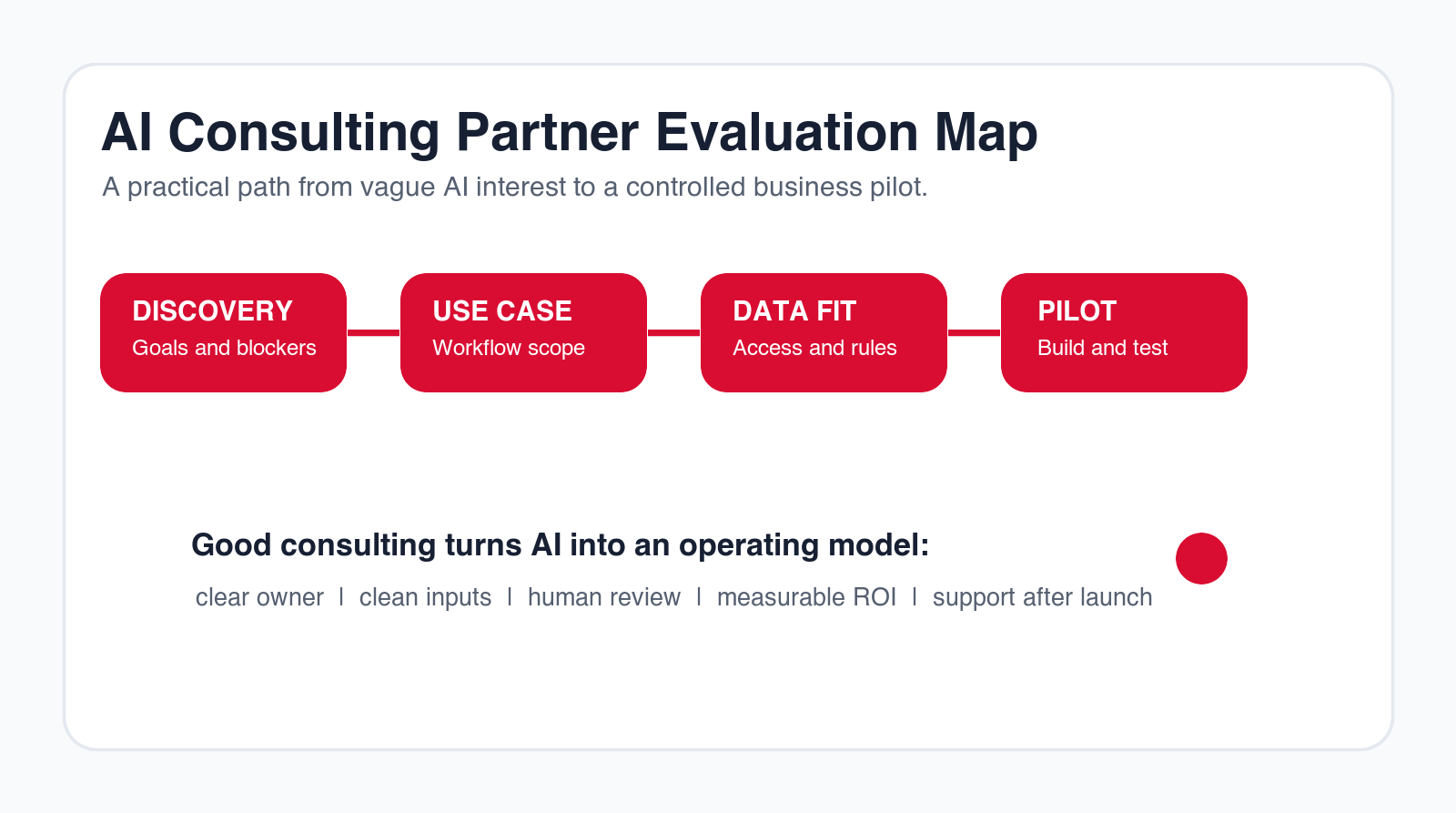
4. They Understand Workflow Automation, Not Just AI Outputs
AI output is only one part of the system. The real business value often comes from moving work from one step to the next. A lead needs to be routed. A ticket needs to be classified. A document needs to be reviewed. A report needs to be assembled. A manager needs an exception alert. This is why an AI consulting company should understand workflow automation.
Ask how the partner handles triggers, routing, approvals, retries, logging, and handoffs. These details determine whether the system works in daily operations. A model that writes a useful summary is helpful. A workflow that captures the source record, creates the summary, sends it to the right person, logs the decision, and updates the system of record is much more useful.
This is also where AI automation agency capability matters. If the partner can only advise, you may still need another team to connect tools and launch the workflow. If the partner can map, build, integrate, and support the process, you have fewer handoffs and a clearer path from consulting to implementation.
5. They Check Data Readiness Early
Data quality decides how much AI can safely do. A strong partner should ask where data lives, who owns it, how clean it is, which fields are reliable, which documents are current, what access is allowed, and which systems need to remain the source of truth. They should also ask what data should not be used.
Data readiness does not mean every database must be perfect. It means the pilot has enough reliable inputs to produce useful outputs. A customer support automation might need a ticket history and a clean knowledge base. A reporting automation might need consistent CRM fields. An invoice review workflow might need purchase order records and supplier rules. The required data depends on the use case.
Watch for partners who treat data as an afterthought. If they say the model will handle messy data without reviewing examples, be careful. AI can work with imperfect inputs, but the workflow still needs boundaries, sample cases, test records, and clear exception handling. Good consulting makes those constraints visible before the build starts.
6. They Can Recommend Custom AI Solutions When Templates Are Not Enough
Many businesses can start with existing tools. Others need custom AI solutions because their workflows, approval rules, data sources, or customer experience are specific. The right AI consulting company should not force every problem into the same tool. It should explain when configuration is enough and when custom development is worth it.
Custom does not always mean large or expensive. It might mean a small internal app that reviews documents, a workflow that connects a CRM and support desk, a retrieval system for internal knowledge, or an AI-assisted queue for operations staff. The key is that the solution fits the process instead of making employees work around a generic interface.
Ask for the decision logic. When would they use an off-the-shelf tool? When would they build a custom workflow? When would they recommend no AI? A credible partner can explain tradeoffs in cost, speed, control, security, maintenance, and user experience.
7. They Know AI Agent Development and Its Limits
AI agent development can be valuable when a workflow requires multi-step reasoning, research, drafting, tool use, or context-aware task handling. An agent might review a queue, gather information, draft a response, update a record, and ask for approval. But agents also need guardrails. They should not be given broad authority before the process is tested.
A good partner should explain what the agent can do, what it can suggest, what requires human approval, what tools it can access, what logs are kept, and what happens when confidence is low. They should also separate agent behavior from workflow automation. Sometimes a workflow needs an agent. Sometimes it only needs rules, integrations, and a narrow AI step.
Avoid partners who present agents as magic employees. Useful AI agents are designed around tasks, tools, permissions, and review paths. They should be measurable and replaceable. If the system cannot explain what the agent did and why, it will be difficult to trust in a business process.
8. They Design Human Review Into the System
Human review is not a sign that AI failed. It is how businesses use AI safely. The first version of an automation should often prepare work, draft outputs, summarize evidence, flag exceptions, and route decisions to the right person. Over time, the system can handle more steps when accuracy and trust are proven.
Ask where humans stay in the loop. For example, support refunds, legal complaints, pricing exceptions, high-value sales opportunities, sensitive HR issues, financial approvals, and customer-facing commitments often need human review. The partner should help define which tasks can be automated, which can be assisted, and which should remain manual.
Good review design also improves training. When users approve, reject, or edit AI outputs, the organization learns what good looks like. That feedback can improve prompts, rules, knowledge sources, and workflow logic. Without review data, teams are left guessing why the system worked or failed.
9. They Handle Integrations, Access, and Security Like Production Work
AI consulting becomes real when the system touches business tools. That might include CRM, help desk, email, spreadsheets, accounting systems, document stores, project management tools, knowledge bases, or internal databases. The partner should be comfortable discussing access, API limits, authentication, roles, logging, and data retention.
Security should not be treated as a final checklist. The partner should ask what data is sensitive, who can view it, where outputs are stored, how accounts are managed, and what audit trail is needed. They should also be clear about third-party tools and model providers. If they cannot explain where data goes, slow down.
You do not need enterprise complexity for every pilot, but you do need production habits. Even a small workflow should have clear ownership, restricted access, basic logging, tested failure paths, and a way to disable or adjust the automation if something changes.
Current AI risk guidance also points in the same direction: map the workflow, measure behavior, manage risk, and improve with evidence. A consulting partner does not need to bury the project in policy, but they should show how the pilot will handle privacy, transparency, security, human review, and monitoring before it touches real customers or internal records.
Ask for this in plain operational language. Which data will the system read? Which output will a person approve? Where will logs live? Who can pause the workflow? What happens when the model is uncertain? If the partner can answer those questions without hiding behind vague AI language, the project is more likely to survive production use.
That is where consulting discipline becomes visible.
10. They Show a Clear Delivery Plan
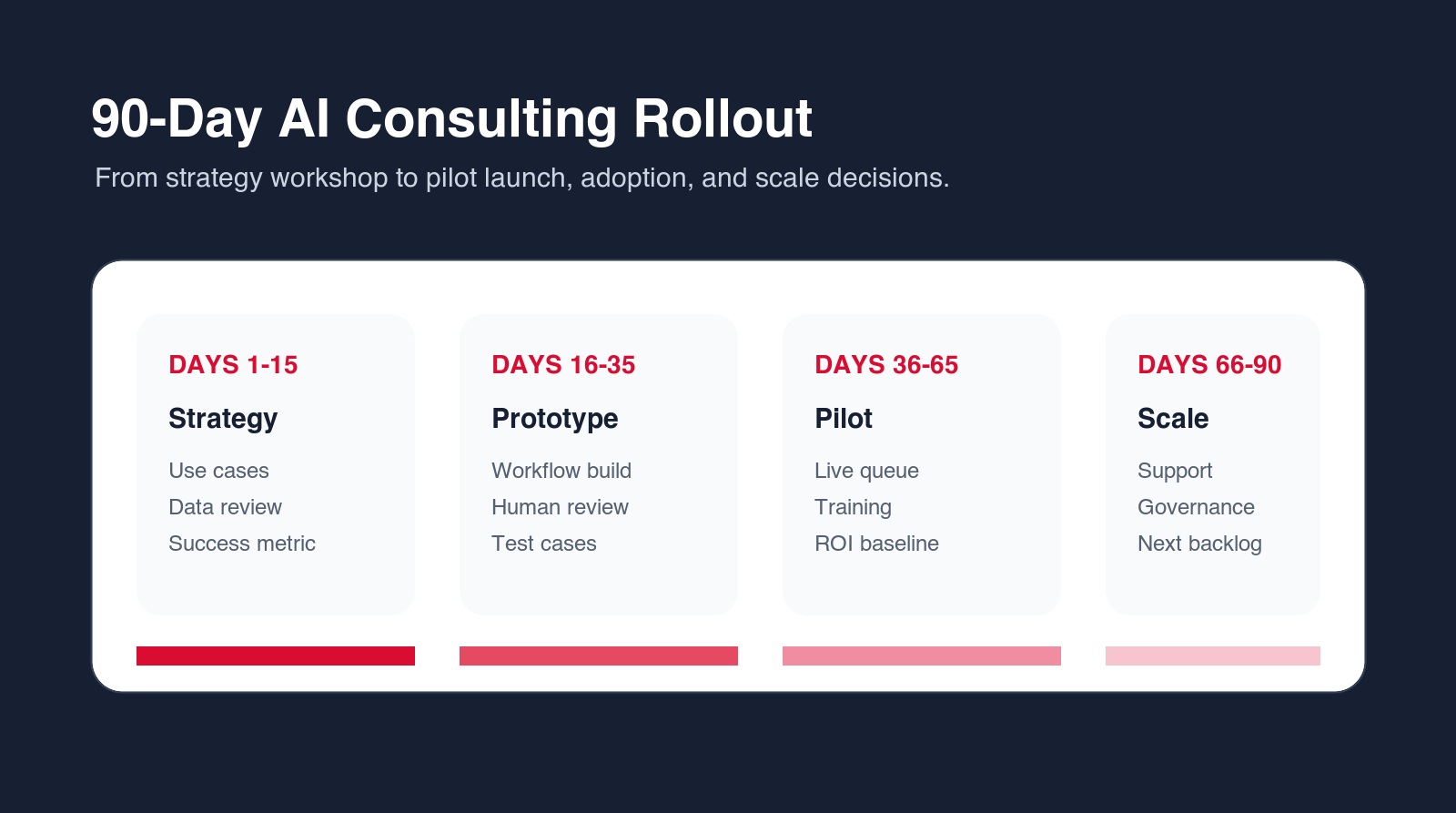
A strong AI consulting company should be able to explain the delivery path before the project starts. The plan does not need to be rigid, but it should show phases, owners, deliverables, review points, and decision gates. You should know when discovery ends, when the prototype is reviewed, when pilot users test, and when the go or no-go decision happens.
A practical plan usually starts with discovery, then workflow mapping, data access, prototype design, pilot build, testing, user training, measurement, and support. The plan should also name what the client must provide. AI projects slow down when nobody owns sample data, system access, policy decisions, or user feedback.
Timelines should be believable. A focused pilot can often move quickly, but only if the process is narrow and the team is available. If a partner promises a complex multi-system AI rollout in days, ask what is excluded. If the plan takes months before anything is tested, ask how value will be proven earlier.
11. They Measure ROI and Adoption, Not Just Technical Completion
A technically finished AI system can still fail if nobody uses it or if it does not improve the workflow. The right partner should define success metrics before the build starts. Useful metrics include time saved, response speed, routing accuracy, rework reduction, data completeness, quality consistency, backlog reduction, user adoption, and manager visibility.
ROI does not need to be complicated. Start with the workflow volume, the time spent per run, the cost of delay, the amount of rework, and the value of faster decisions. Then compare the baseline with pilot results. The point is to decide whether the system is worth supporting and expanding.
Adoption matters because AI changes how people work. A partner should ask who will use the system, what they need to trust it, what training is required, and how feedback will be collected. If users see the automation as extra checking, they will avoid it. If they see it as removing repetitive work, adoption becomes easier.
12. They Train the Team and Support the Change
AI consulting should not end when the pilot goes live. Users need to understand what the system does, what it does not do, when to trust it, when to review it, and where to report problems. Managers need to understand the metrics and support process. Administrators need to know how changes are requested.
Training should be specific to the workflow. A generic AI training session may be helpful, but it will not replace practical guidance inside the process. For example, a support team needs to know how to review suggested replies. A finance team needs to know how invoice exceptions are flagged. A sales team needs to know how lead summaries are created and where corrections are logged.
Ask what support looks like after launch. Who monitors issues? How are prompts, rules, integrations, or knowledge sources updated? What happens when the workflow changes? A good partner will explain maintenance before the project starts because AI systems need care after release.
13. They Are Honest About AI Tools Versus Custom Builds
The best answer is not always custom development. Sometimes a business should use existing AI automation tools, workflow automation software, or features already inside the CRM, help desk, document platform, or productivity suite. A good AI consulting company should be willing to recommend the simplest path that solves the problem.
The opposite is also true. Existing tools can become limiting when workflows require custom approvals, unusual data sources, strict user experience, private knowledge retrieval, or multi-step actions across systems. In those cases, custom AI development may produce a better fit than forcing the team into a generic product.
The partner should explain the tradeoff. Tools can be faster to launch, easier to maintain, and cheaper at the start. Custom builds can offer more control, better workflow fit, and stronger integration with existing operations. The right choice depends on risk, urgency, budget, data, and how central the workflow is to the business.
14. They Make Pricing, Scope, and Responsibilities Clear
AI consulting pricing can vary widely because projects range from advisory workshops to full implementation. What matters is not only the price. It is whether the scope is clear. You should know what is included, what is excluded, how many workflows are covered, which integrations are included, what the deliverables are, and what happens after launch.
Ask whether the engagement is discovery-only, strategy plus pilot design, implementation, or ongoing support. Ask what client access is required, how many revision cycles are included, how testing works, and what counts as a change request. Clear scope reduces conflict and keeps the work focused.
Be careful with both extremes. A very cheap offer may skip discovery, testing, or support. A very expensive offer may include unnecessary strategy layers before any workflow is improved. The right partner should connect price to business value, project risk, and the amount of work needed to ship responsibly.
15. They Leave You With a Maintainable AI Operating Model
A good AI consulting company should leave your business stronger after the engagement. That means your team should understand the workflow, the system owner, the review path, the metrics, the support process, and the backlog of future improvements. You should not be dependent on a mystery setup nobody can explain.
Maintainability includes documentation, access control, prompt or rule management, system diagrams, testing notes, known limitations, and a process for requesting changes. It also includes a decision model for future projects. Once the first pilot works, the business should know how to evaluate the next use case.
The long-term goal is not one impressive demo. The goal is a repeatable way to improve operations with AI. A partner who can help you build that operating model is more valuable than one who only delivers a short-term prototype.
Comparison Table: Weak Partner Versus Strong Partner
Use this table when comparing proposals. It helps separate broad AI talk from practical delivery capability.
| Area | Weak signal | Strong signal |
|---|---|---|
| Discovery | Talks about AI before understanding the workflow. | Maps process, owner, data, risk, and measurement first. |
| Pilot | Promises a broad transformation immediately. | Defines one measurable pilot with a review path. |
| Build | Only sells advice or only sells one tool. | Can recommend tools, automation, agents, or custom solutions. |
| Risk | Treats human review as unnecessary. | Defines permissions, exceptions, logs, and approval points. |
| Support | Disappears after launch. | Explains training, monitoring, updates, and ownership. |
Questions to Ask Before You Hire an AI Consulting Company
Good questions reveal whether the partner can think beyond the pitch. Ask these before signing:
- Which workflow would you recommend we evaluate first, and why?
- What data do you need before you can design the pilot?
- What should humans review in the first version?
- Which existing tools should we use before considering custom AI development?
- What integrations are required for the pilot to be useful?
- How will we measure success after 30, 60, and 90 days?
- What will our team need to maintain after launch?
- What would make you recommend not using AI for this process?
The last question is especially important. A trustworthy partner can tell you when AI is not the right answer. That honesty saves budget and builds trust. Sometimes the first step is cleaning data, documenting the process, improving forms, or connecting systems before adding AI.
Free AI consulting checkup
Find the first AI project worth scoping.
Put your work email below and we will send a quick first-pass review path for choosing your first AI consulting or automation pilot.
Red Flags When Comparing AI Consulting Companies
Some warning signs show up quickly. Be careful if a partner promises guaranteed savings before seeing the workflow, avoids data questions, cannot explain human review, ignores integrations, has no support model, or uses the same demo for every business. Be careful if the proposal has no measurable pilot and no clear owner on your side.
Also watch for partners who make AI sound risk-free. Useful AI systems need testing, permissions, monitoring, and iteration. Risk does not mean you should avoid AI. It means the partner should design the system with realistic boundaries. A business can move quickly and still stay controlled.
The strongest partners are usually specific. They can say, "This workflow is a good first candidate because it has volume, clear inputs, and measurable time savings." They can also say, "This other workflow should wait because the data is weak or the decision is too sensitive." Specific thinking is a better signal than big claims.
Final Checklist: Choose the Partner That Can Ship Safely
Before you choose an AI consulting company, make sure the partner can answer five questions. What business problem are we solving? Which workflow will we pilot first? What data and integrations are needed? Where does human review belong? How will success be measured after launch?
If those answers are clear, you are closer to a useful AI project. If the answers are vague, slow down. AI consulting should reduce uncertainty, not hide it behind technical language. The right partner will help you make a small, smart, measurable move first, then expand from there.
One more practical test helps: ask the partner to write the first workflow brief before any build starts. The brief should name the trigger, inputs, data source, AI action, user role, approval point, output, failure path, metric, and owner. If that brief is clear, the project can move into design. If it is vague, the team is probably buying ambition instead of a usable system. This small document often reveals whether the consulting company understands operations, not only AI terminology and vendor positioning, before budget, tooling, or model decisions become harder to change later.
Go Expandia approaches AI consulting this way because most businesses do not need a vague AI transformation. They need a practical path from workflow problem to pilot, from pilot to supported system, and from one system to a repeatable automation model. That is how AI becomes an operating capability instead of a disconnected experiment.
Author
About Bailey Roque
Bailey Roque writes for Go Expandia on AI consulting, automation strategy, workflow design, AI agents, and practical AI adoption for business teams.
The focus is on use-case selection, human review paths, data boundaries, rollout planning, and turning AI pilots into supported operating workflows.
About Go ExpandiaFAQ: AI Consulting Company
What does an AI consulting company do?
An AI consulting company helps a business identify useful AI opportunities, map workflows, review data readiness, design pilots, choose tools, build or guide implementation, define human review, measure ROI, train users, and support rollout.
How do I choose the right AI consulting partner?
Choose a partner that starts with business outcomes, understands workflow automation, checks data readiness, can scope a small pilot, designs human review, explains integrations and security, and supports adoption after launch.
Should I hire an AI consulting company or buy AI tools?
If your workflow is simple and already supported by an existing product, a tool may be enough. If you need use-case selection, data review, integration, custom AI solutions, AI agents, governance, or rollout support, a consulting partner can reduce risk.
How long does an AI consulting project take?
A focused discovery and pilot planning phase can often start within days. A practical pilot may take a few weeks depending on workflow complexity, data access, integrations, review rules, and testing needs.
Can Go Expandia provide AI consulting services?
Yes. Go Expandia helps businesses choose AI use cases, map workflows, plan pilots, build AI automation and agents, connect systems, train teams, and support rollout after launch.
Ready to Choose the Right AI Consulting Partner?
Go Expandia helps companies move from AI interest to practical consulting, automation pilots, AI agent development, and custom AI solutions that teams can actually use.