
AI Services in Barcelona
Barcelona AI services guide for companies and AI users
Barcelona is a practical city for AI adoption because business demand, digital talent, research infrastructure, multilingual operations, and international commerce meet in one compact metropolitan area. Companies based in the city often need AI for very concrete reasons: faster customer response, less manual administration, clearer sales follow-up, better data retrieval, sharper reporting, and more reliable handoffs between teams. The best AI projects in Barcelona are not abstract showcases. They are operational systems that help people do normal work faster, with fewer mistakes, in the languages and tools the company already uses.
Go Expandia serves Barcelona as a remote-capable AI agency. That means this page is about service coverage, not a public office location. We work with companies that want AI automation, AI consulting, AI agent development, and custom AI solutions without turning the project into a large internal research program. The goal is to help a Barcelona team identify the work that should be automated, protect the information that must stay private, build the right workflow, train the users, and keep the system improving after launch.
This guide gives Barcelona teams clear service-area facts: what Go Expandia provides, who the services are for, how remote delivery works, which use cases fit, and how to evaluate a practical AI partner.
Quick service facts
Go Expandia provides AI agency services for businesses in Barcelona, Catalonia, and nearby Spanish or European markets. The service categories are AI automation agency, AI consulting services, AI agent development, custom AI solutions, AI opportunity review, AI plan, AI build and setup, AI training, and AI support. The page is not claiming a walk-in office in Barcelona. It is a service area page for companies that can work through remote discovery, secure document exchange, video workshops, shared project systems, and structured implementation calls.
The ideal client is a business team that already has recurring work, customer messages, sales notes, support tickets, documents, spreadsheets, CRM records, product data, or operational reports that take too much human time to process. Good Barcelona use cases include multilingual customer support, proposal drafting, lead routing, invoice follow-up, supplier research, booking and hospitality workflows, logistics coordination, retail stock reporting, professional services knowledge search, real estate listing operations, marketing production, and internal help desk automation.
The city context matters. Barcelona companies frequently operate in Catalan, Spanish, and English. Some also serve French, German, Italian, Dutch, Portuguese, Arabic, or international tourism markets. AI workflows in Barcelona should therefore be built with language control, tone control, privacy boundaries, review steps, and clear escalation paths. A chatbot that answers only in English is usually not enough. A useful system should recognize language, preserve local terminology, hand over sensitive questions, and keep a clear audit trail of what it used to answer.
Why Barcelona is a strong AI service market
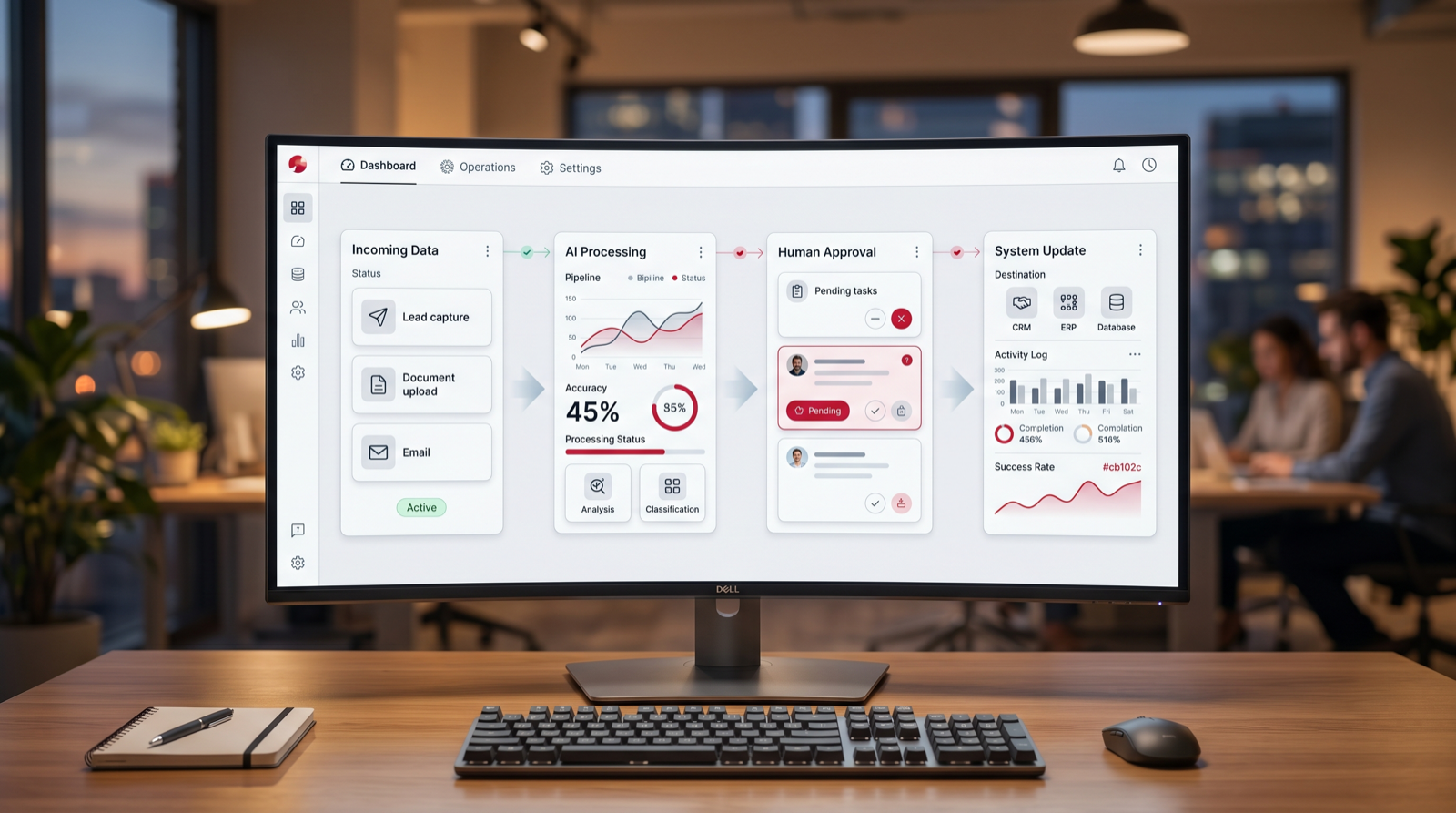
Barcelona is not just a destination city. It is a dense operating environment for digital business. The local economy includes tourism, hospitality, trade fairs, design, logistics, life sciences, gaming, retail, real estate, manufacturing, education, professional services, and a deep pool of startups and international workers. These sectors create a practical need for AI systems that connect front office and back office work. A hotel group may need multilingual guest response and reservation support. A software company may need AI-assisted qualification and onboarding. A logistics operator may need document extraction and exception monitoring. A legal, tax, or advisory firm may need private knowledge retrieval across client files and regulations.
Public digital strategy also shapes the market. Barcelona city institutions describe technology as a way to make services more accessible, strengthen public services, support innovation, and improve everyday city life. The city has promoted digital talent, data governance, RPA, digital rights, and technological entrepreneurship as part of its broader digital agenda. That local language is important for private companies too. It pushes serious AI adoption toward explainability, inclusion, governance, and measurable usefulness, not only novelty.
Barcelona also has a visible high-performance computing and AI research anchor through the Barcelona Supercomputing Center. MareNostrum 5 and the BSC AI Factory show that the city has a serious AI and computing identity, even when a normal SME does not need supercomputer access. This matters because it affects talent, conversation quality, vendor expectations, and the way managers think about AI. Barcelona buyers are likely to hear both ambitious research language and practical commercial pressure. A good implementation partner must translate between those worlds.
For most businesses, the immediate opportunity is not to train a frontier model. It is to connect reliable AI components to the existing work of the company. That may mean a retrieval system over internal documents, an agent that drafts answers from approved knowledge, a workflow that prepares reports from spreadsheets, or an automation that routes requests from email to CRM to Slack or Microsoft Teams. Barcelona has enough digital maturity for these systems to be useful, but many companies still need help narrowing the scope so they do not overbuy technology.

What AI users in Barcelona usually need first
The first need is clarity. Many teams have tested ChatGPT or another AI tool informally, but they have not converted those tests into a dependable business workflow. They may have one person who gets good results from prompts, another team that is worried about privacy, and a manager who wants proof that AI will save money or increase revenue. The work starts by turning scattered interest into a use case list, then ranking each use case by value, risk, data readiness, user adoption, and integration complexity.
The second need is data hygiene. Barcelona teams often keep useful knowledge across Google Drive, Microsoft SharePoint, Notion, Dropbox, CRM notes, email threads, spreadsheets, PDFs, booking platforms, support tools, and supplier portals. AI cannot safely improve work if it cannot distinguish the current source of truth from old drafts, duplicates, informal notes, or private records. A good first project often includes document cleanup, access boundaries, naming conventions, data extraction rules, and a clear decision about what an AI system may read.
The third need is language and tone control. Many Barcelona businesses speak to different audiences in different registers. A B2B software company may use English for investor updates, Spanish for national sales, Catalan for local administration, and another language for customer success. A hospitality team may need friendly guest communication without promising things the property cannot deliver. A legal or advisory team may need formal answers with disclaimers and human review. Prompting alone is not enough; the system must have examples, policies, and evaluation checks.
The fourth need is integration. AI becomes valuable when it meets the user where work already happens. That can mean drafting a CRM follow-up after a call, summarizing a support ticket before a handoff, preparing a proposal from a product catalog, extracting invoice details into an approval sheet, or creating a daily operations summary from several tools. The fewer extra tabs a team has to open, the higher the adoption. Barcelona companies with hybrid and international teams especially benefit from AI that lives inside existing workflows.
High-value AI use cases for Barcelona companies
Customer support and multilingual service
Customer support is a natural starting point. Barcelona companies often serve local and international customers, so support teams need multilingual answers, consistent policy handling, and fast escalation. A support AI can search approved help content, draft replies in the customer's language, summarize prior history, flag refund or legal issues, and route complex cases to a person. The system should not pretend to be an office or invent policy. It should use known material, show confidence, and make handoff easy.
Sales operations and lead routing
Sales and lead operations are another strong use case. AI can classify inbound leads, enrich account notes, draft first replies, prepare discovery call briefs, write follow-up emails, and remind the team when a qualified opportunity goes quiet. For Barcelona companies that sell across Spain, the EU, the UK, or North America, this can reduce the delay between interest and response. It also improves consistency because the sales team sees the same account context, product notes, and next-step suggestions before each interaction.
Hospitality, logistics, and service operations
Hospitality and tourism workflows are especially relevant in Barcelona. AI can help with guest questions, group booking requests, local recommendation content, cancellation policy explanations, cleaning or maintenance tickets, and multilingual review summaries. The key is to keep the system grounded in the property rules and current availability. A useful AI should know when to answer, when to draft for a human, and when to say that the team must confirm. That protects guest experience while reducing repetitive work.
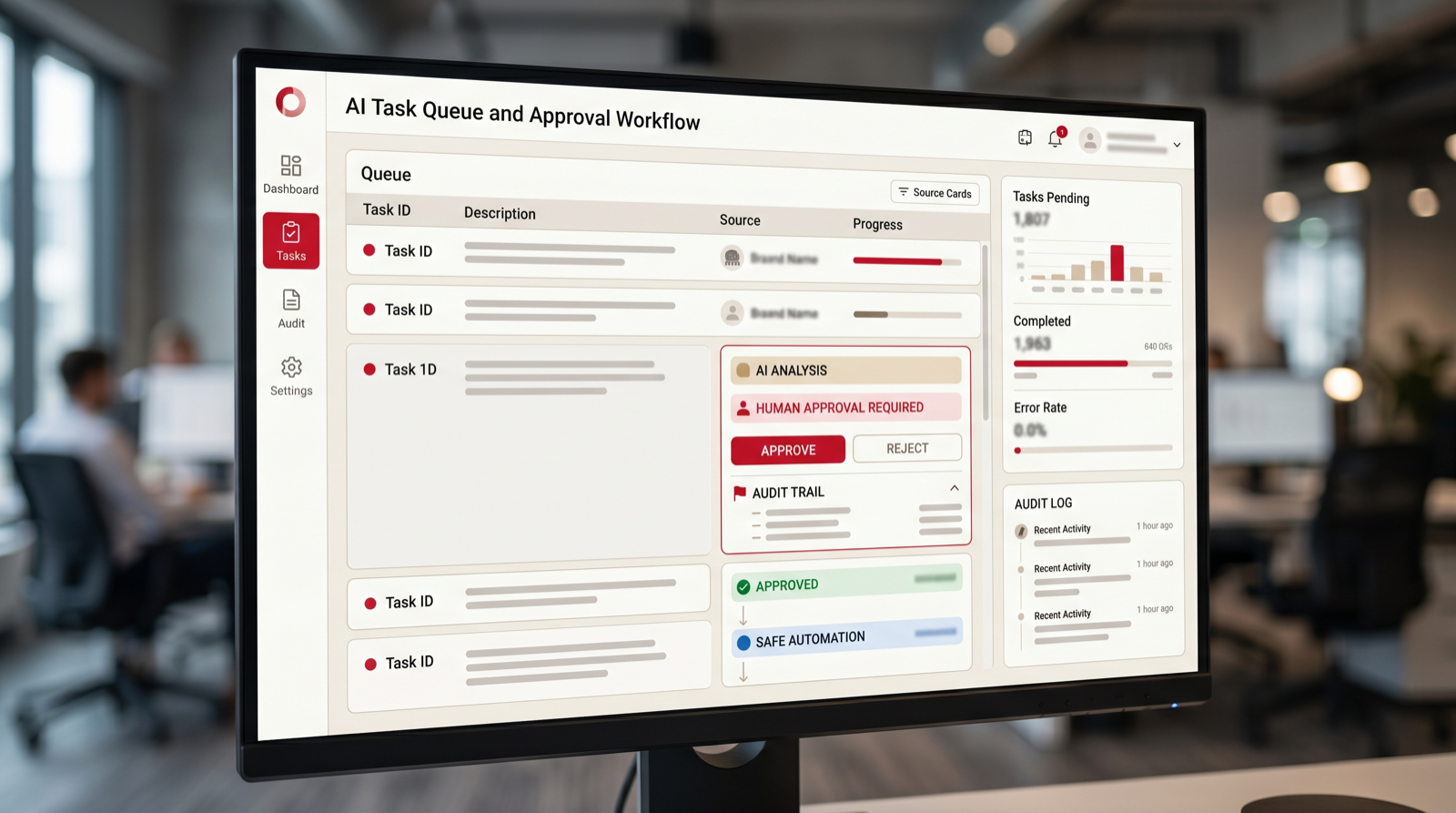
Logistics and trade workflows fit Barcelona because the city is a Mediterranean business gateway. Companies dealing with shipments, suppliers, customs documents, purchase orders, and delivery exceptions can use AI for document extraction, status summaries, anomaly detection, and supplier communication drafts. These projects should be built with strict audit trails. People need to know which document was read, what fields were extracted, which values are uncertain, and who approved the final action.
Professional services firms can use AI for knowledge retrieval, client intake, research summaries, proposal generation, meeting preparation, and internal quality checks. In these environments, privacy and review are central. The AI should not freely mix one client's information with another client's material, and it should not present uncertain text as legal, financial, or technical advice. A good professional services AI system supports the expert; it does not pretend to replace professional responsibility.
Retail, ecommerce, and consumer brands can use AI for product descriptions, merchandising analysis, customer segmentation, campaign drafts, inventory reporting, review analysis, and customer service. Barcelona brands that sell to tourists, local customers, and international online buyers need consistent product language across channels. AI can help produce and translate content, but it should be tied to product data, brand voice, compliance rules, and current inventory. Otherwise it may create attractive copy that is operationally wrong.
Real estate and property companies can use AI for listing operations, lead qualification, document collection, viewing follow-up, landlord reporting, tenant communication, and maintenance triage. Barcelona's property market is sensitive, regulated, and multilingual, so AI systems must be careful with claims, availability, pricing, and legal language. The best use is often internal assistance: summarizing inquiries, preparing reply drafts, checking required fields, and keeping the team organized across many conversations.
Manufacturing and industrial firms near Barcelona can use AI for maintenance logs, quality documentation, supplier evaluation, production reporting, safety training, and technical knowledge search. These projects need practical engineering discipline. The AI must respect version control, equipment manuals, approved procedures, and human sign-off. A plant does not need a theatrical AI tool. It needs fewer missed details, faster access to the right procedure, and clearer communication between operations, management, suppliers, and customers.
How Go Expandia works with Barcelona teams
The five-step delivery model
The first step is an AI opportunity review. We look at the work that repeats, the tools the team already uses, the data that can be safely reviewed, and the business outcome the company wants. The review is deliberately practical. It asks where AI could increase revenue, reduce cost, shorten response time, protect cash flow, improve quality, or remove unnecessary manual work. The output is not a long theoretical report. It is a ranked set of opportunities with a suggested order.
The second step is an AI plan. A good plan defines the workflow, user roles, data boundaries, integrations, review steps, risks, success metrics, and launch sequence. This matters in Barcelona because many companies have multilingual teams and mixed tool stacks. The plan should say which languages are supported, which documents are authoritative, which actions need human approval, which tools need integration, and which metrics prove that the workflow is working. Without that structure, AI projects drift.
The third step is build and setup. We create the automation, agent, retrieval workflow, dashboard, internal tool, or custom AI application around the chosen use case. This can include connecting an LLM to approved knowledge, building a controlled prompt system, integrating a CRM or help desk, creating extraction logic, setting up human review, or designing a small internal interface. The build should be narrow enough to launch, but not so narrow that it cannot be used in daily work.
The fourth step is training. Training is not a one-hour presentation about AI in general. It is specific to the workflow that was built. Users need to know when to trust the system, when to review, when to escalate, how to correct bad output, what data not to paste, and how to judge whether the result is good enough. Barcelona teams often include multiple languages and roles, so training material should reflect the real users, not a generic demo audience.
The fifth step is AI support. A launched system needs monitoring, improvements, bug fixes, prompt updates, data updates, user feedback, and occasional redesign. If a policy changes, a product line changes, a CRM field changes, or a new language becomes important, the AI workflow should adapt. Ongoing support is where many projects become valuable because the first version teaches the team what they actually need from the second version.
Data privacy, security, and governance
AI adoption in Barcelona must respect European privacy expectations, client confidentiality, and internal access rules. A practical AI workflow should begin with data classification. Which data is public? Which data is internal? Which data is confidential? Which data contains personal information? Which data should never be sent to an external model? Which users are allowed to see the output? These questions sound basic, but they are the difference between a useful AI system and a risky shortcut.
Governance should be built into the workflow rather than added later as a document nobody reads. For a support agent, governance may mean approved knowledge sources, answer confidence, refusal rules, logging, and human handoff. For a sales assistant, it may mean CRM field permissions, tone rules, and limits on claims. For a document extraction system, it may mean confidence thresholds, exception queues, and reviewer approval. For a knowledge assistant, it may mean permission-aware retrieval so users cannot query files they should not access.
Barcelona companies should also plan for multilingual governance. A policy written in English may not cover the way a support answer sounds in Spanish or Catalan. A translation may be accurate but too informal. A local phrase may carry a different expectation. The AI workflow should include examples and evaluations in the real languages the business uses. If the company serves tourists or international accounts, the evaluation set should include those languages too.
Security also includes operational discipline. Teams should avoid pasting sensitive data into unmanaged tools, creating shared accounts with unclear access, or building important processes around personal browser extensions. A production AI workflow should have owned accounts, documented access, known vendors, backup procedures, and a clear owner inside the business. AI can be flexible, but the operating model should be boring in the best way: clear, repeatable, and recoverable.
Remote AI delivery for Barcelona teams
Go Expandia serves Barcelona businesses through remote discovery, planning, implementation calls, secure document exchange, and ongoing support. The core services are AI automation, AI consulting, AI agent development, custom AI solutions, AI opportunity review, AI planning, build and setup, training, and support.
This is a service area page rather than a walk-in office listing. Remote delivery works well for software workflows, knowledge retrieval, automations, reporting systems, and internal tools when scope, data access, review responsibilities, and success metrics are clear.
Barcelona teams can use the page to understand what a first AI project should include: a concrete workflow, real examples, language requirements, privacy boundaries, human review, and a measurable business result.
How to choose an AI agency in Barcelona
A Barcelona business should choose an AI partner by looking at the quality of the questions the partner asks. Weak vendors start with tools. Strong vendors start with workflow, risk, data, users, and outcomes. Before anyone proposes a chatbot, agent, automation, or dashboard, they should understand what work is currently done manually, who owns the process, what data is available, what output is considered correct, what failure would look like, and how the business will measure value after launch.
Ask whether the partner can explain the difference between a demo and a production workflow. A demo can look good with sample data and a friendly prompt. A production workflow has messy inputs, user mistakes, edge cases, changing policies, permissions, rate limits, integrations, and support expectations. Barcelona companies that serve customers in several languages should test the system with real multilingual examples before calling it ready.
Ask how the partner handles privacy. They should be able to explain data boundaries, vendor choices, logging, retention, access control, and human review without hiding behind vague phrases. Ask how they prevent the system from inventing answers. Ask how they evaluate output. Ask how they update the knowledge base. Ask what happens if the model changes. Ask who owns the workflow after the project ends. The answers do not need to be complicated, but they should be concrete.
Ask for a small first project with a real business metric. Good starting metrics include response time, minutes saved per ticket, percentage of leads routed correctly, number of documents processed per week, manual follow-up reduction, proposal turnaround time, support backlog reduction, or reporting hours saved. If a vendor cannot connect the AI system to a measurable business result, the project may become a novelty rather than an operating asset.
Recommended first project roadmap
Week one should be discovery and selection. The team lists candidate use cases, maps the current workflow, reviews sample data, names the users, identifies risks, and chooses one first project. The first project should be valuable but contained. It should touch a real workflow, but it should not require every system in the company to change at once. The team should also agree on what data can be used during discovery.
Week two should define the workflow. This includes the exact trigger, input, AI task, data source, review step, output, integration, and metric. For example: when a support email arrives, classify the issue, retrieve the correct policy, draft an answer in the customer's language, show the source, ask a human to approve, then log the result. This is much clearer than saying "build a support AI."
Weeks three and four should focus on build, test, and revision. The system should be tested with real examples, including difficult cases. A Barcelona hospitality workflow should test English, Spanish, Catalan, and common tourist languages if those are relevant. A B2B workflow should test messy CRM notes and incomplete lead forms. A document workflow should test low-quality PDFs and missing fields. The purpose is not to embarrass the system. It is to discover the guardrails before launch.
Week five should prepare launch. Users need training, documentation, escalation rules, and a place to report problems. Managers need a metric dashboard or at least a simple way to review value. Someone needs ownership. If the system uses knowledge documents, someone must own updates. If it drafts messages, someone must own tone and policy. If it extracts data, someone must own validation. Clear ownership keeps the project alive.
After launch, the team should review performance weekly at first. Which prompts fail? Which cases are escalated? Which source documents are missing? Which users avoid the tool? Which outputs need editing? These findings are not signs of failure. They are the normal path from first release to useful operating system. AI work becomes durable when feedback is treated as product input, not as blame.

Barcelona sector notes
For SaaS and technology companies, the strongest AI projects are often sales operations, customer success, onboarding, support knowledge, internal documentation, and product feedback analysis. Barcelona SaaS teams may have distributed customers and international staff, so the AI should support English while still handling local operating needs. The best systems reduce response time and help users find the right information without forcing every employee to become a prompt expert.
For agencies and creative firms, AI can support research, briefing, content variation, localization, asset tagging, campaign reporting, and proposal preparation. Barcelona has a strong design and creative culture, so AI should be used carefully. The goal is not to flatten the brand voice into generic copy. The goal is to speed production while protecting originality, approvals, client context, and quality control.
For healthcare, wellness, and life sciences teams, AI projects should be conservative and well governed. Useful areas include internal knowledge retrieval, appointment administration, document summarization, research monitoring, and operational reporting. Any patient, clinical, or regulated workflow needs specific legal and professional review. AI should support qualified people and administrative processes; it should not create unsupported medical claims.
For finance, accounting, tax, and advisory teams, AI can help with document collection, client intake, deadline tracking, meeting summaries, knowledge search, and recurring report drafts. These teams need strong confidentiality, source references, and review. The most valuable systems are often private internal assistants that help experts move faster while keeping final responsibility with the human professional.
For education and training providers, AI can help with course material adaptation, student support drafts, intake questions, learning content search, administrative routing, and multilingual communication. Barcelona attracts international students and professionals, so language flexibility matters. The system should make learning support easier without replacing instructors or giving students unverified answers to high-stakes questions.
What not to automate first
Do not start with the most sensitive workflow in the company. If the business has never launched an AI system, avoid beginning with legal decisions, medical advice, financial approvals, hiring decisions, or any process where a wrong answer creates immediate harm. Those areas may benefit from AI later, but they require more governance and stronger validation. Start with a useful workflow where risk can be bounded and learning can happen safely.
Do not automate a broken process without fixing the process. If nobody agrees on the source of truth, AI will amplify confusion. If the CRM is filled with duplicates, an AI workflow will inherit that mess. If support policies conflict, the AI will choose among bad options. A good project may include process cleanup before automation. That can feel slower, but it prevents the team from building a fast version of the wrong workflow.
Do not buy a platform only because it has many features. Barcelona businesses, especially SMEs, can lose time comparing AI tools while the actual workflow remains undefined. Start with the business problem, then choose the lightest technical setup that can solve it properly. Sometimes that is an existing SaaS feature. Sometimes it is a custom workflow. Sometimes it is a simple internal tool. Complexity should earn its place.
Useful public context for Barcelona AI research
Public sources reinforce the idea that Barcelona is a serious digital and AI environment. The Barcelona Institute for Innovation and Technology describes the city's focus on digital innovation, data governance, public service transformation, technology for everyday city life, digital talent, innovation, and competitiveness. Barcelona Digital highlights topics such as digital talent, entrepreneurship, ethical use of AI, digital rights, and resources for digitalization. These themes are directly relevant to business AI adoption because they shape expectations around responsible and useful technology.
The Barcelona Supercomputing Center is also part of the local AI story. BSC material around MareNostrum 5, the Spanish AI strategy, multilingual language models, and the BSC AI Factory points to Barcelona's role in high-performance computing and AI infrastructure. A normal business buyer does not need to become a supercomputing expert, but this context helps explain why Barcelona has a higher-quality AI conversation than many markets. The city has both practical business demand and serious research credibility.
For Barcelona buyers, the takeaway is simple: Barcelona is a relevant city for AI services because it combines international business, multilingual operations, digital talent, public digital strategy, and advanced computing institutions. Go Expandia's role is to help companies turn that environment into working business systems: automations, agents, retrieval workflows, custom AI tools, training, and support.
Frequently asked questions
Does Go Expandia have an office in Barcelona?
This page is a Barcelona service area page, not a public office listing. Go Expandia can support Barcelona companies through remote discovery, planning, build sessions, implementation calls, secure file exchange, and ongoing support. If a project requires specific in-person work, that can be discussed for the individual engagement.
What AI services are available for Barcelona businesses?
The main services are AI opportunity review, AI planning, AI automation, AI agent development, custom AI solution build and setup, AI training, and AI support. These services can be used independently or as a full path from first assessment to production workflow.
Can AI workflows support Catalan, Spanish, and English?
Yes, multilingual support is often a core requirement for Barcelona. The exact language setup depends on the use case, source material, model choice, evaluation examples, and review process. A responsible workflow should test the real languages the company uses before launch.
What is the best first AI project for a Barcelona SME?
The best first project is usually a contained workflow with repeated work, available data, clear users, low-to-medium risk, and a measurable outcome. Examples include support reply drafting, lead routing, document extraction, proposal preparation, meeting summaries, internal knowledge search, or recurring report automation.
How long does a first AI implementation take?
A small first workflow can often be scoped and tested in a few weeks, depending on data access, integrations, user availability, and governance needs. More complex projects involving several systems, regulated data, or multiple departments need a longer rollout and stronger validation.
Can Go Expandia improve an existing AI setup?
Yes. Many companies already have AI tools but need better prompts, evaluation, data boundaries, workflow design, training, or integrations. Support can focus on improving output quality, reducing risk, connecting the tool to daily work, and making the setup easier for the team to use.
How should a company prepare for an AI consultation?
Prepare examples of repetitive work, current tools, sample documents, common questions, problem metrics, and any privacy constraints. It also helps to name the people who own the workflow. A good consultation is much more useful when it starts with real operating details.
How should buyers read this service area page?
Use this as a practical overview of Go Expandia AI automation, consulting, agent development, custom AI solutions, training, and support for Barcelona businesses. It describes remote-capable service coverage, not a physical office address.
Build the first useful AI workflow for your Barcelona team.
Start with one real process, one measurable outcome, and a system your team can actually use. Go Expandia can help you review the opportunity, plan the workflow, build the first version, train the users, and support the system after launch.
Talk to Go Expandia